
Delta County Criminal History Checks
Start a Delta County criminal record search with MiCOURT Case Search. It is the official public route for filed trial-court cases. Search the 94th District Court as well as the 47th Circuit Court when a felony may have moved after a probable-cause hearing. A case number is the best key. A first and last name can work, but spelling, filing year, and court level help separate people with similar names.
Then choose the source that answers the next question. The jail handles local custody. The arresting agency holds its own report. ICHAT supplies public, reportable Michigan history. OTIS covers MDOC custody and supervision. No one result is a full Delta County criminal history.
- Search MiCOURT by case number or participant name, and note the court attached to each result.
- Check both Delta County court levels when the record concerns a felony that may have been bound over.
- Use ICHAT for the public state-repository view, with date of birth and exact spelling ready.
- Call the Delta County Sheriff for current jail custody, recent booking facts, or its own incident records.
- Request filed documents from the court clerk and the police narrative from the agency that made the report.
- Compare the disposition across MiCOURT and ICHAT, then ask the source office to correct a mismatch.
Delta County Records at 310 Ludington
The Delta County Courthouse at 310 Ludington Street in Escanaba is the main court-record hub. The County Clerk, Prosecuting Attorney, 94th District Court, and 47th Circuit Court use the courthouse as their public anchor. The shared county number is (906) 789-5100. Callers should name the specific court or office because “records” could mean a District Court register, a Circuit Court judgment, a prosecutor file, or a sheriff report kept elsewhere.
The Delta County directory identifies the officials and contact route for these offices. Its captured page shows why the directory is useful before a call.
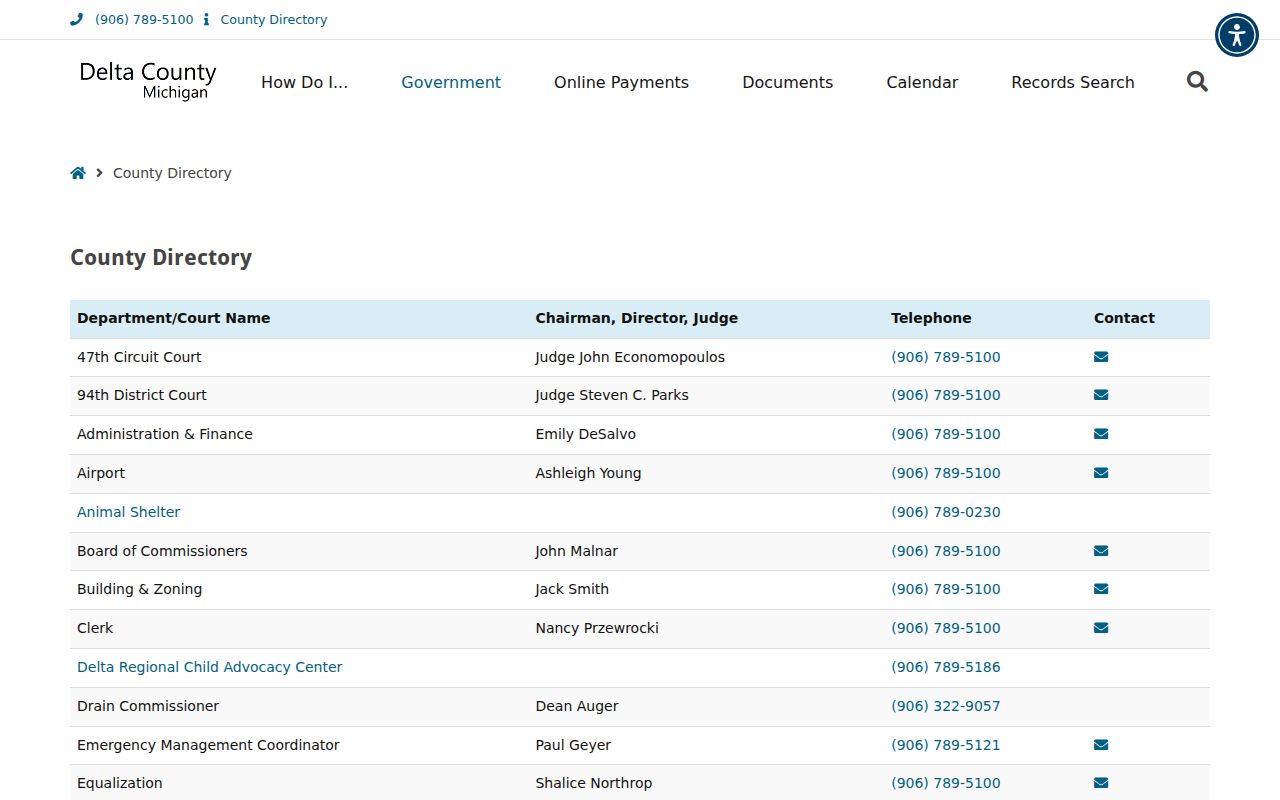
The directory helps a searcher ask for the 94th District Clerk, 47th Circuit Clerk, Sheriff, or Prosecutor instead of relying on a broad switchboard request. Police reports from Escanaba remain at its Department of Public Safety, not at the courthouse.
Official Background Checks in Michigan
The Michigan State Police Criminal Justice Information Center maintains the state repository. Its public product, ICHAT, is a $10 name and date-of-birth search. The report can include public Michigan felony arrests and convictions and serious misdemeanor convictions that were reported successfully. It excludes warrants, federal, tribal, out-of-state, juvenile, traffic, suppressed, and minor local misdemeanor material. A “no record” response therefore does not settle every criminal-record question.
The official Michigan State Police criminal-history page compares name checks, fingerprints, court records, and corrections records.
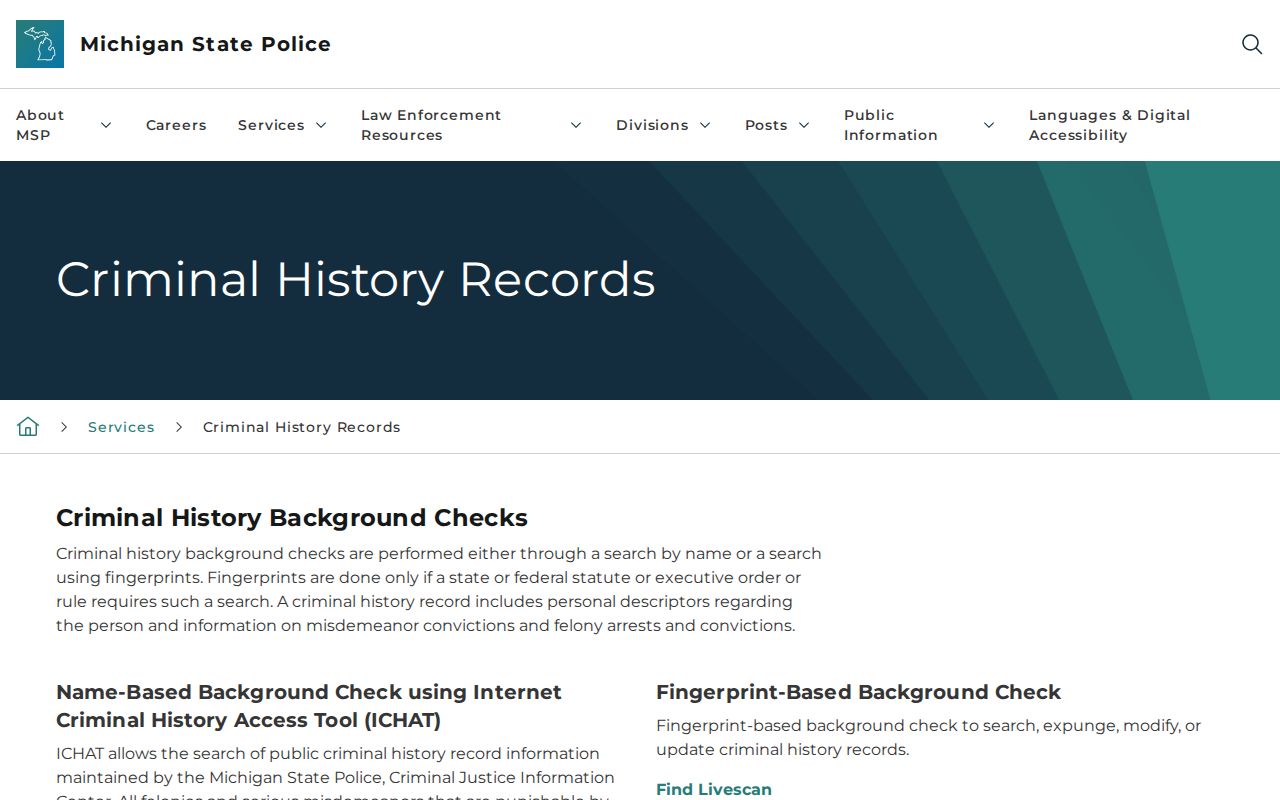
The comparison reinforces a key limit: ICHAT is not fingerprint-confirmed. For personal record review or an authorized statutory fingerprint process, follow MSP instructions and use the supplied RI-030 form with a Michigan-authorized Live Scan vendor or law-enforcement site.
| Official product | Identity basis | Scope | Located fee |
|---|---|---|---|
| ICHAT | Name and date of birth | Public reportable Michigan history | $10 per search |
| MSP fingerprint record | Fingerprints | Purpose-dependent state or federal response | Verify the statutory code and vendor fee |
| FBI Identity History Summary | Fingerprints | FBI-maintained subject history | Verify the current FBI fee |
| Delta court search | Case number or name | Filed Delta County cases | Public search is free; copy fees may apply |
Delta County ICHAT Name Matches
ICHAT asks for the subject’s name and date of birth during its account and payment flow. Social Security and driver-license numbers are not searchable. Check the spelling, birth date, and gender before submitting because the $10 charge applies to the search. State guidance says a result remains available on the transaction day plus seven days, so save or print it in that window.
A Delta County ICHAT entry may show descriptors, aliases, an arresting agency, charges, court, disposition, and sentence data. It is still a repository compilation, not the original case file. If a disposition is absent, compare it with MiCOURT and contact the court that entered the outcome. If identity itself is disputed, use MSP’s fingerprint-based personal review route.
| Channel | Best answer | What it does not prove |
|---|---|---|
| MiCOURT | Filed cases, hearings, and outcomes | A complete rap sheet or police narrative |
| ICHAT | Public Michigan repository history | Warrants or fingerprint identity |
| Delta jail contact | Current or recent local custody | A conviction |
| OTIS | MDOC custody and supervision | Local jail status or complete history |
Kinds of Criminal Records
A single Delta County event can create several records with different dates and wording. An incident report describes an investigation. An arrest report explains custody and alleged offenses. The jail adds a booking record. The prosecutor decides what charge to authorize, and the court records the filed allegation and final outcome. MSP may then receive the arrest fingerprint event and disposition for the repository.
- District Court case
- The file for an arraignment, misdemeanor, or preliminary felony proceeding in the 94th District Court.
- Circuit Court case
- The 47th Circuit Court file for a felony after bind-over, including plea, trial, sentence, and later motions.
- ICHAT history
- The public portion of reportable Michigan repository events, not a copy of every local file.
- OTIS profile
- An MDOC custody or supervision record rather than a complete criminal history.
- PSOR profile
- A statutory registry record, separate from an ordinary rap sheet.
Charge language may change at each step. The booking charge is what the jail received. The filed charge is the prosecutor’s allegation. The conviction offense reflects the adjudicated result. Treat each as a statement from a different point in the Delta County process.
Delta County Charging Records
The Delta County Prosecuting Attorney stands between an arrest report and a filed criminal charge. The elected prosecutor’s office reviews reports from the Sheriff, Escanaba and Gladstone Public Safety, MSP, DNR, and other authorized agencies. It may authorize the allegation as submitted, change the charge, add a count, or decline prosecution. That review is why a booking label can differ from the complaint later shown in MiCOURT.
The official Delta County Prosecuting Attorney page places the prosecutor at 310 Ludington Street with the trial courts and clerk. It lists three attorneys and five support staff, with duties that include adult and juvenile misdemeanors and felonies, appeals, police training, victim services, and abuse or neglect work for MDHHS. Those staffing facts explain the office’s role, but they do not make its file a substitute for the clerk’s public register.
For a Delta County criminal record search, use the complaint or Circuit Court information to identify the formal count. Use the judgment of sentence for the final adjudicated offense. A police narrative can add the investigative facts, while the prosecutor’s charging decision and court outcome show what the justice system did with them. The office’s subpoena line serves subpoena business and is not a general court-record search line.
Delta County Jail Has No Live Roster
The official Delta County Correctional Facility page is informational. The research did not locate a confirmed public web roster or booking log. For current custody, call the Sheriff at (906) 789-5100 with a full legal name, date of birth, approximate booking date, and arresting agency if known. Ask for booking status, court, bond by count, and release or transfer status. Some facts may be withheld.
This distinction blocks a common mistake. A third-party list is not an official Delta County jail source, and OTIS is not the county jail. OTIS serves MDOC prisoners, felony probationers, parolees, and people within three years of discharge. It leaves out local-jail-only sentences.
Delta County Criminal Records: What They Contain
The public fields depend on the source. MSP criminal history may include names, aliases, date of birth, physical descriptors, identifying numbers, arrest cycles, charges, dispositions, and sentence information. MiCOURT centers on the case number, court, parties, filed counts, events, hearings, judgment, and financial or document data that the participating court exposes. Local police and jail records add report and booking details.
| Name & identifiers | Legal and alias names, date of birth, and permitted descriptors used to distinguish the subject. |
|---|---|
| Arrest & booking | Agency, event date, booking number, facility, charges received, bond, and custody status where released. |
| Charges & statutes | Count descriptions and Michigan law citations, which may differ from the first booking label. |
| Disposition | Dismissal, bind-over, plea, conviction, acquittal, or another final court result. |
| Sentence | Jail, prison, probation, fines, costs, or other terms when publicly reported. |
| Supervision | MDOC custody, parole, or felony probation data may appear through OTIS. |
Match a Delta County event across sources with the court, case number, arresting agency, charge, and date rather than a name alone. A missing field may reflect the product’s scope, a reporting delay, a redaction, or a Michigan set-aside rule, so the office that created the disputed fact is the right correction point.
Delta County Warrant Record Chain
No official public Delta County active-warrant database was found, and ICHAT expressly omits warrants. Begin with the 94th District Court for its own bench or criminal warrant tied to a case. MiCOURT may show relevant docket events, but a sealed or unserved warrant may not appear. The law-enforcement LEIN system is not open to public search.
For verification or surrender instructions, call the Delta County Sheriff at (906) 789-5100 and do not approach a wanted person. Ask the issuing court about bond and the proper appearance process. After a warrant is recalled or satisfied, obtain written court confirmation because database updates can lag.
Michigan Public Access Laws
Michigan FOIA applies to existing, nonexempt records held by public bodies. It does not force an office to create a new report, answer research questions, or supply a record held by another agency. A public body generally must respond within five business days, though one ten-business-day extension is allowed. A response may grant, deny, partially grant, or point to a free web copy. Court records also follow judicial rules and clerk practice, so an agency FOIA is not a substitute for a certified court document.
Key Michigan laws:
MCL 15.231 states Michigan’s policy favoring access to public records.
MCL 15.235 sets the response framework and permissible extension.
MCL 15.243 lists privacy and law-enforcement exemptions.
MCL 780.621 defines key limits for application-based conviction set-asides.
Active investigations, juvenile material, victim data, confidential sources, safety-sensitive information, and protected identifiers can be withheld or redacted. Ask for a specific date range, report number, location, and record type to help the custodian find an existing Delta County record.
Delta County OTIS Versus ICHAT
Use ICHAT to review public, reportable Michigan criminal history by name. Use OTIS to locate MDOC prisoners or verify qualifying probation and parole supervision. OTIS accepts a last name or MDOC number and offers filters for first name, sex, age, race, status, and exact scar, mark, or tattoo wording. A wildcard can follow at least three starting surname letters.
The official MDOC OTIS page frames the corrections search available to Delta County readers.
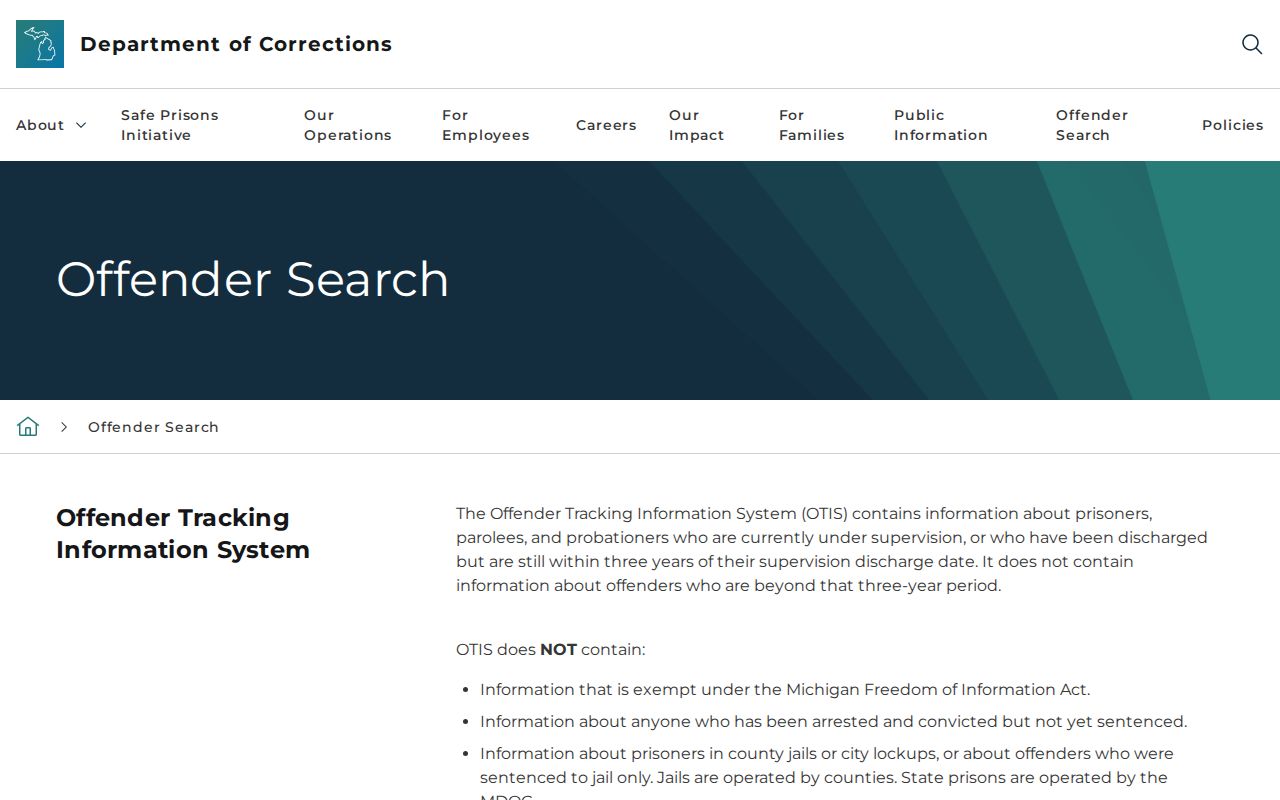
An OTIS profile can show an MDOC number, aliases, a photo, physical description, status, location, sentencing offenses, term dates, supervision office, and discharge information. It does not cover the Delta County jail or people beyond its stated discharge window.
Restricted, Sealed & Expunged Records
Michigan uses “set aside” and “expungement.” Clean Slate includes application-based relief and automatic processing. Eligibility turns on the offense, conviction count, waiting period, pending charges, and statutory exclusions. A Delta County application normally begins in the court of conviction, often with SCAO form MC 227, a certified conviction record, fingerprints or state-record material as directed, service on required agencies, and a hearing when scheduled.
Automatic relief does not happen at once for every case. It also does not destroy every police report, news item, or public document. Check ICHAT and the Delta County court file after the expected process. If the repository still shows a disposition that the court has changed, begin correction with the source court and follow MSP’s record-review instructions.
Delta County Probation and Parole Records
MDOC Field Operations Region 1 supervises Delta County felony probationers and parolees, while the sentencing court keeps judicial authority. The 94th District Court administers misdemeanor probation through its local framework. The Michigan Parole Board within MDOC makes parole decisions for state felony prisoners. These roles are distinct from jail custody and from a trial-court conviction file.
The current MDOC Field Operations directory is the right place to identify a supervising office.
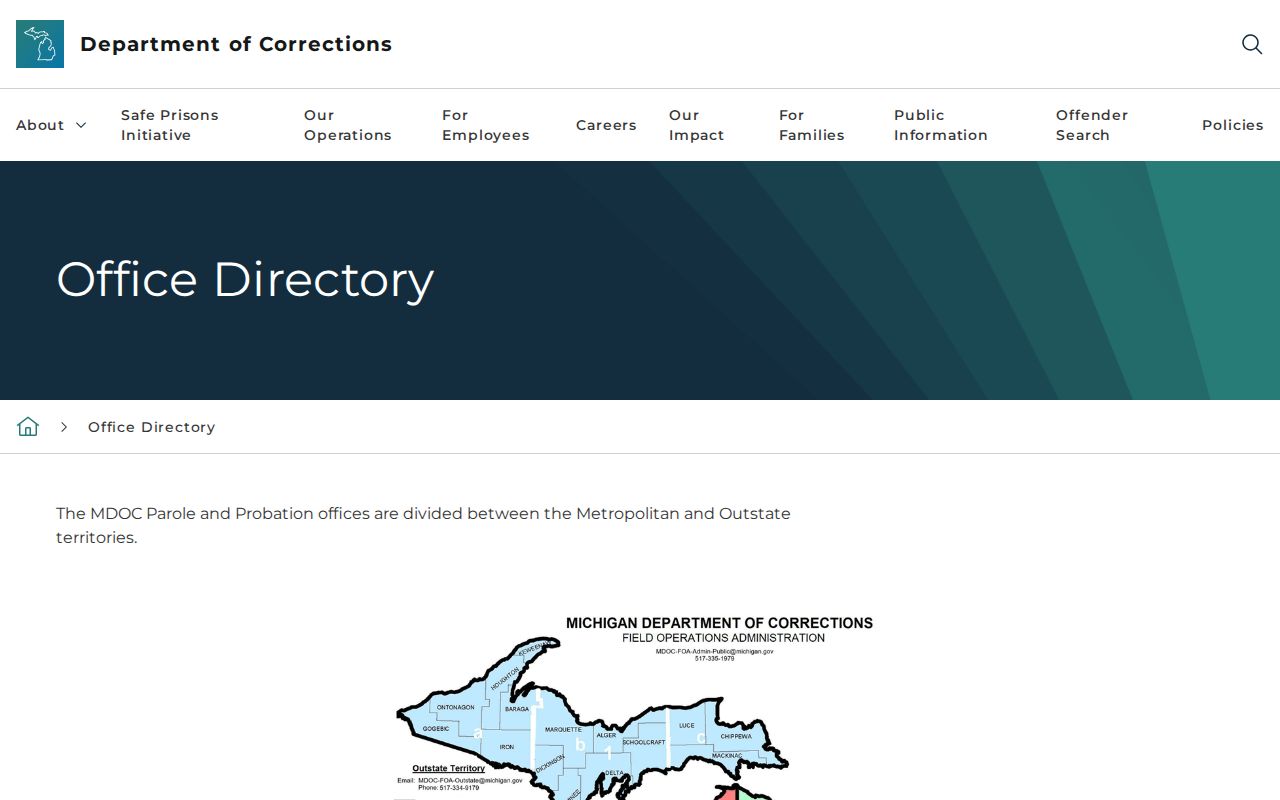
Use the office listed in OTIS or the live Region 1 directory rather than an old address snapshot. Supervision-status questions go to that office; a court-originated sentence error goes back to the sentencing court.
The Michigan Parole Board page supplies the current state contact and authority details.
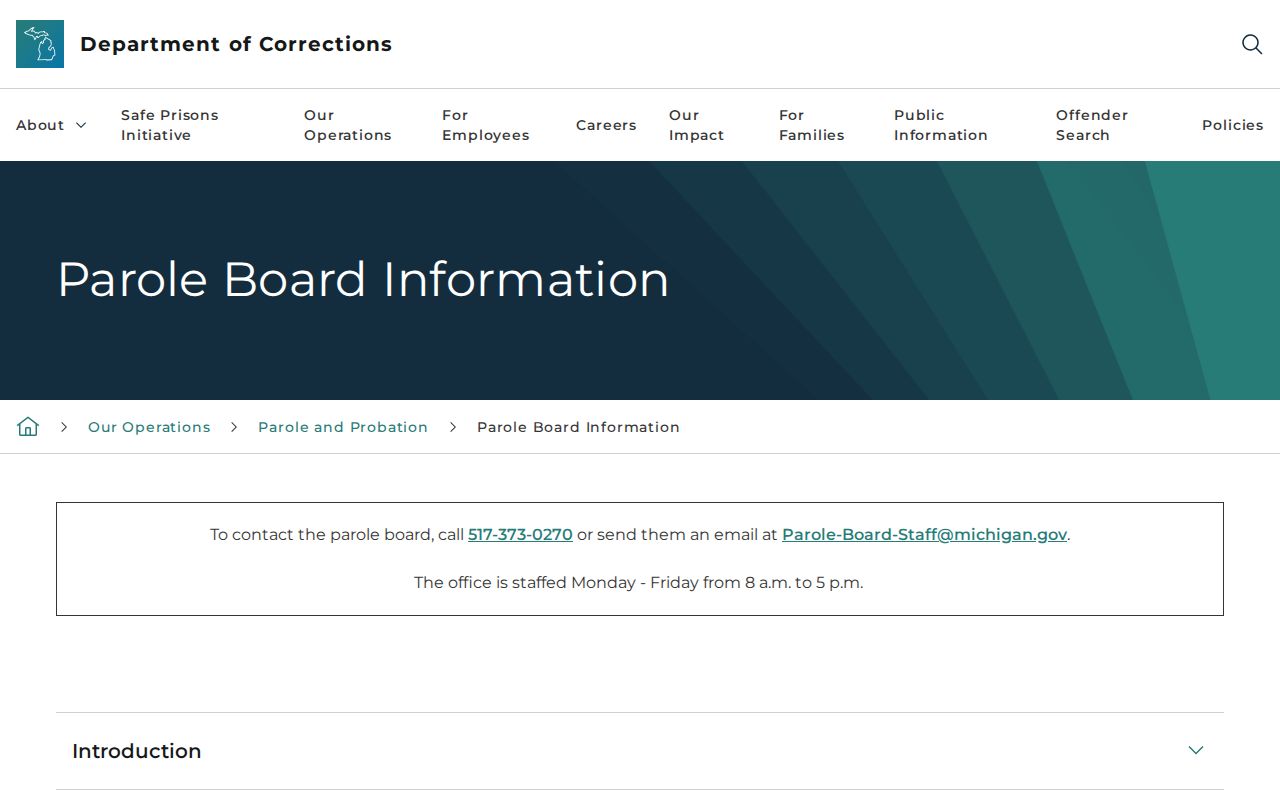
The Board’s role is release decision-making for MDOC prisoners. It does not replace MiCOURT for the conviction or the Delta County Clerk for filed court documents.
Delta County Arresting Agency Matters
Delta County spans two cities, the Village of Garden, many townships, rural roads, and waterfront territory. A deputy, Escanaba or Gladstone public-safety officer, MSP trooper, DNR conservation officer, or federal or tribal officer may create the first report. That agency remains the report custodian even when the person later enters the Delta County Correctional Facility and the prosecution moves into the county courts.
Escanaba has a dedicated police-report FOIA form. Gladstone accepts FOIA requests through its city clerk. Garden has no verified standalone police department, so identifying whether the Sheriff, MSP, or DNR responded is the key first step. Reported crime, arrests, and convictions will not match because each measures a different stage and agency coverage varies.
City-by-City Criminal Records in Delta County
Escanaba and Gladstone keep their own Public Safety incident files, while Garden relies on the agency that answered the call. All three places route filed adult criminal cases through Delta County courts. Garden is an incorporated village, not a city, but it is the county’s third incorporated place and belongs in the local record routes.
Escanaba Record Check
County seat with its own Public Safety report form and county court access.
Gladstone Record Check
Public Safety records begin with the Gladstone FOIA coordinator.
Garden Record Check
Village records depend on whether the Sheriff, MSP, or DNR responded.